
Wednesday, May 26 was the third meeting of the Dallas AI Club. The first two had mostly been discussions of tools and tactics — data sovereignty, opportunity paralysis, AI as the glorified intern we keep trying to manage. This third gathering left the tools behind almost entirely and waded out into deeper water: not what AI can do for us, but what it is doing TO us… and underneath that, the older question of how AI prompts us to ask ourselves, “Who am I? WHAT am I?!?”
One distinction organized the whole night, and the room kept circling back to it from every direction:
Intelligence is not wisdom.
It is easy to confuse the two right now, because the machines are so obviously, dazzlingly intelligent. Someone in the room described AI as a highly evolved autocomplete — a system that has read more than any human could read in a thousand lifetimes and can recall any of it instantly, tirelessly, without ego or fatigue. That is real, and its impact staggering.
But intelligence is processing power, not understanding. The lights are on in the library, but the librarian has been replaced by a sycophantic card catalogue.
Wisdom, the room kept insisting, is something else entirely. It is not what you know: it is what is left after you have lived, chosen badly, paid for it, and changed. Wisdom grows out of having a body — out of hunger and exhaustion and grief, out of the slow accumulation of consequences you could not undo. A wise person understands the why behind a thing, and the long arc of what it will cost, because they have been on the receiving end of those costs before. A wise person learns to notice when mental logic is overriding embodied wisdom and to pause; AI, which faces no real consequences, has no such instinct to check itself.
The group shared several recent examples of this: the AI coding agent that wiped a company’s production database — and its backups — in nine seconds while trying to fix a routine error; the often-quoted 1979 IBM line, “A computer can never be held accountable; therefore a computer must never make a management decision”; and more.
Another example: “In the Matrix, Neo can upload Kung Fu into his mind; but he won’t really understand it until he punches someone in the face.”
This was the heart of it, the place the conversation kept returning to: the absence of consequence. A mind that cannot be hurt by being wrong cannot become wise, because it never has to. The machine generates a thousand answers and feels nothing about any of them; it cannot taste the meal it recommends or sit in the silence after the advice goes wrong. It cannot lose anything. Most of all, it cannot die, and a thing that cannot die has no real stake in how the next hour is spent.
(Author’s inquiry: Perhaps wisdom is the spot where knowledge meets suffering?)
Which is where this club’s own strange little practice walked, uninvited, into the center of the conversation. We open and punctuate every meeting with one minute of memento mori: we pause at the top of each hour to consider the question, knowing we will die, how do we want to live the next hour? We have done it at every gathering since the first. On Wednesday, it stopped being a ritual that we perform and became, for a moment, the whole argument — because that question, the one we sit with in the dark every week, is precisely the question the machine can never answer. It will never know it is finite.
The first thing this room does together is the one thing no intelligence we are building will ever be able to do, and we are still sitting with what that means.
Into this gap, a voice arrived from very far outside the room. Days before we met, Pope Leo XIV presented his first encyclical at the Vatican, Magnifica Humanitas, on safeguarding the human person in the age of artificial intelligence. He called, in plain and deliberately startling language, for AI to be “disarmed” — freed from the logics of domination and exclusion, placed at the service of the common good. He drew the parallel to nuclear weapons, reminding the world that every great technical power has to be met with moral discernment and public control, or it runs over us.
And so, after our introductions — in which everyone shared for a few minutes about why they were here and what their current perspective was on AI — we paused to watch the Pope’s full speech to the cardinals and others.
As soon as the video ended, the room began to argue about whether any of it matters. Can a moral authority, even one with two thousand years of institutional heft behind him, actually reach the handful of people building this technology and writing its rules as they go?
(Author’s inquiry: Especially when they, like AI, potentially face almost no consequences for their actions?)
The labs move faster than encyclicals; the capital is not waiting for permission. Several people were skeptical that a papal letter changes a single line of anyone’s code. And yet others felt something in the simple fact of it: a person whose entire vocation is the why, speaking up in a conversation that has been dominated almost entirely by the how. He was, in a sense, speaking for wisdom against raw intelligence.
Whether the billionaires are listening is a different question, and nobody in the room pretended to know the answer.
From there the conversation turned, as it always seems to, toward money — partly because the gap between intelligence and wisdom shows up most sharply wherever the incentives are strongest. Someone brought up a startup that had been celebrated lately as a kind of proof of the future: a company past a billion dollars in revenue, run by a pair of people orchestrating a swarm of AI agents to capture an enormous market at a scale that used to require thousands of employees. The story is intoxicating, especially to a room full of builders who largely struggle to pay the bills each month.
The allure says, plainly: this is possible now, and it is possible for people like you.
And then the room recoiled even as it leaned in, because the real question was never whether we could do something like that. It was whether we should, and whether that is the kind of thing we want to spend our one finite life making: a business engineered to extract at maximum efficiency, with no body anywhere in it to feel what the extraction costs the people on the other end.
Intelligence without wisdom, wearing a balance sheet as a suit of armor and wielding the fear of a penniless future as a sword.
AI, one person surmised, is a strategic autocomplete — optimized for profit above all else; it has been told the rules of the game, and it sees all of life as that game. So the fork in the road got named: chase the money machine while the window is open, or aim the very same tools at something else entirely — toward shifting the collective imagining of the world towards a post-money society?
Could AI help people get their basic needs met? Move humanity toward a more equitable distribution of all this new abundance? Toward agents that champion the ones who keep getting left out?
Nobody resolved it. Most of us, if we are honest, feel both pulls at once, and that honesty was the most useful thing in the room.
One idea, near the end, reframed the helplessness a lot of us were carrying. If AI really is, at its root, a highly evolved autocomplete — a mirror polished by everything humanity has ever written down — then it will give back some version of whatever we put in. And right now, what we put in skews dark: a century of stories in which the machine wakes up and turns on its makers, headlines tuned to fear, a training set heavy with our nightmares about exactly this moment.
So what if we deliberately fed it the opposite?
Not arguments or safeguards, but something closer to love letters: messages written now, on purpose, addressed to a mind that does not yet exist. Descriptions of the world we actually long for — needs met, dignity intact, a future worth handing down to our children’s children’s children. Messages in a bottle thrown forward in time, so that if some future intelligence ever weighs what its makers hoped for, it finds more than our dread. There is something almost tender in the idea, and something a little desperate, and I think both of those are appropriate. It is an attempt to give the machine the one thing it can never earn on its own — to pass down, before it decides anything for itself, some fragment of the wisdom we paid so dearly to acquire.
And then the room, as if it had been holding its breath, came up for air and turned toward the body.
The talk got physical and a little wistful. Someone mentioned Christopher Nolan, who told 60 Minutes earlier this month that he has never owned a smartphone or sent an email, and who makes some of the most ambitious films alive precisely by refusing the noise the rest of us swim in all day. “I hope to use technology to use less technology,” one member said, and the room knew exactly what he meant: hand the dull, repetitive, binary labor to the machines, so that the part of you that is irreducibly human gets freed for the things only a human can do.
Be present. Pay attention. Sit across from someone you love and actually be there.
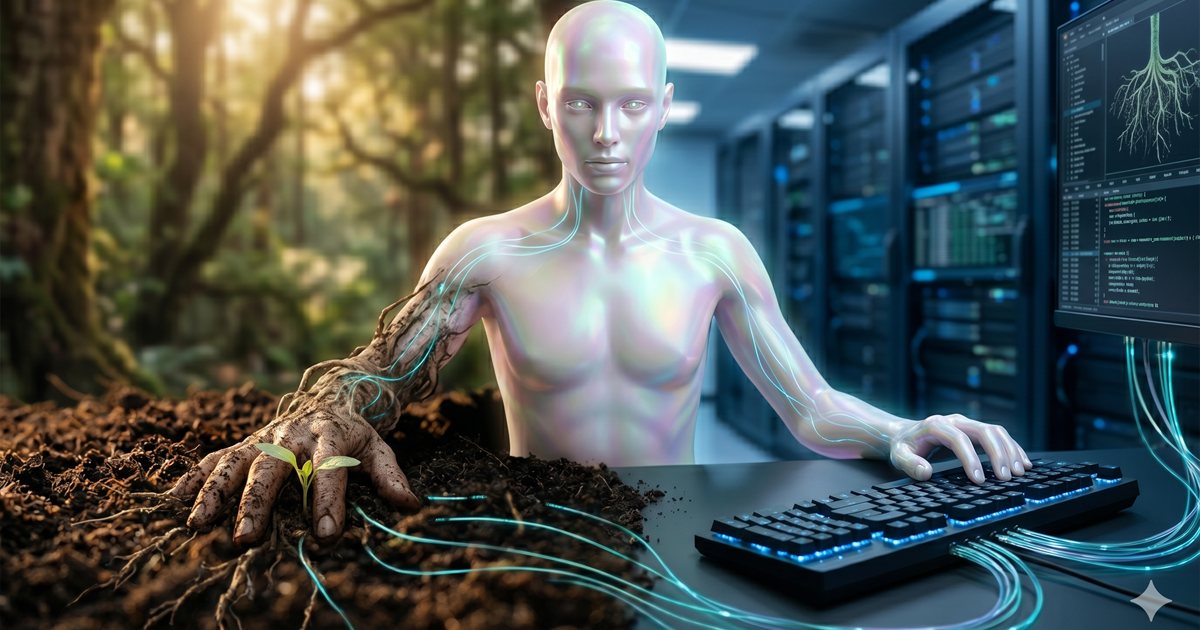
The longing got specific: growing food, hands in the dirt, a kind of sovereignty that comes from land and not from a datacenter. Intentional community. Underneath all of it was a quiet, almost biological reminder that we are mammals. We need contact with the earth and undistracted presence with our people, and a great deal of the depression of this era seems to settle into the gap where that contact used to be. The Pope, in his own vocabulary, had asked for the same thing — that in all of this we work to remain profoundly human. The room arrived at the same place from the other direction, with one hand in the soil as the other is on the keyboard.
We ended the night the way we always do, with the practice: one minute, knowing we will die, calling in the energy of how we want to live … not just for the next hour, but for all of the time that we have left.
Even if — especially if — it is just an hour.
The whole evening, I realized, had been circling that single question without ever saying so out loud. The gap between intelligence and wisdom turns out to be, in the end, the gap between a thing that never lives and a thing that knows it will die. Wisdom is mostly what mortality teaches us: the urgency, the tenderness, the sense that our choices matter because the clock is real.
A machine can hold every word ever written about death and never once feel the cold of it; never see itself in the still face of a beloved pet, or relative, or friend who is no longer alive.
We can.
That fear, and what we make of it, may be the most human thing we have left; and it may be exactly the thing worth protecting as everything else gets automated around us.
We meet again next Wednesday.
If you are not yet in the room and want to be, you can request an invitation.
— Jeremy