
Meeting at a glance
- Small group of three
- One member opened with two analogies for the current phase: the farmer plowing and the potter kneading clay
- Live-tested Anveshi’s Trailhead audit tool with UX feedback and real-time iteration
- Watched and discussed the video AI’s Dirty Lie on the AI capital cycle
- Discussed various members’ ventures in development:
- an AI-powered accountability coach
- an AI-powered tutoring service
- a sacred hackathon for AI developers
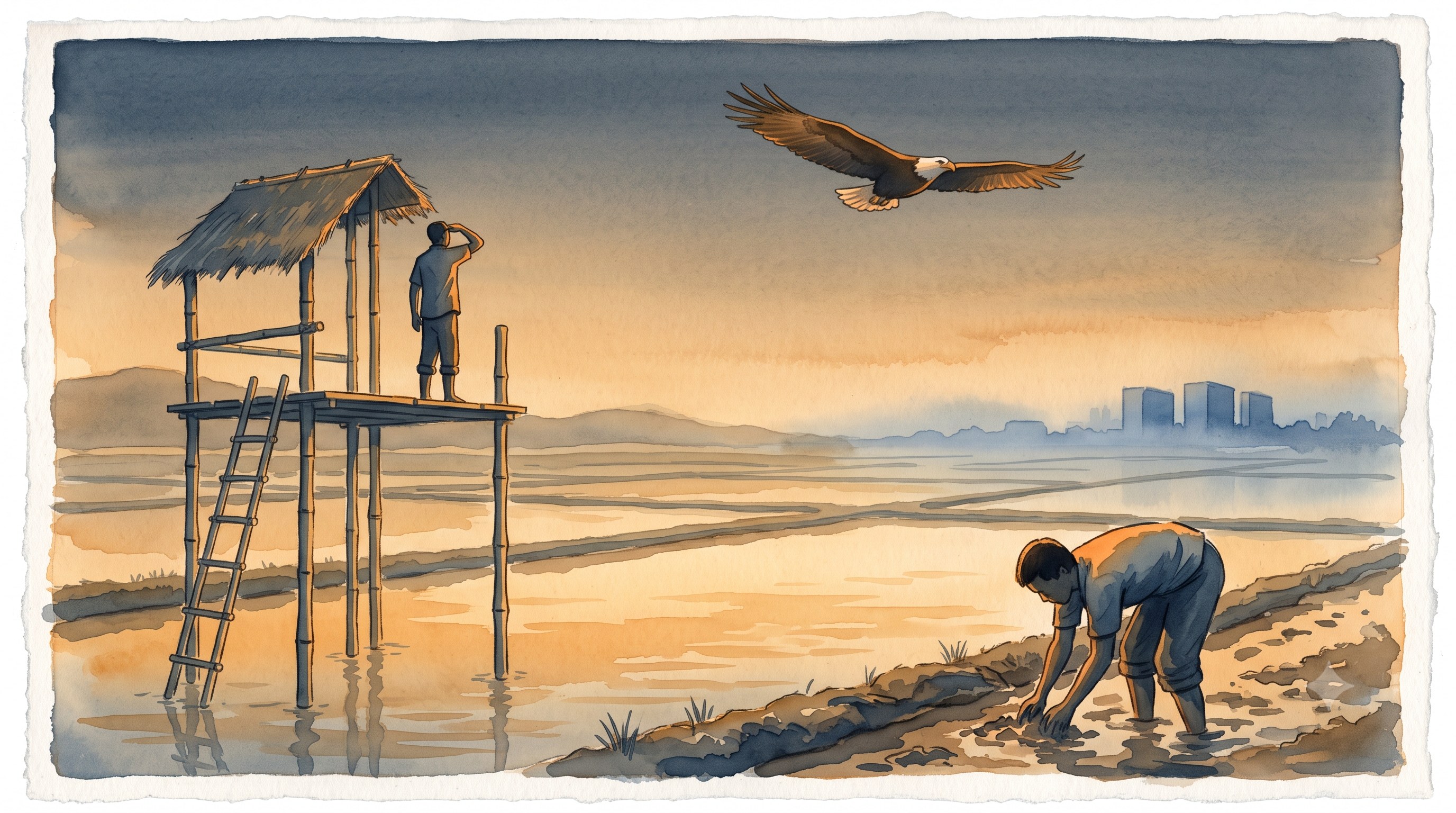
- Reflected on the meeting itself as a return to the same field from a higher vantage point, which we dubbed “The Eagle’s Nest”
Wednesday was the ninth meeting of the Dallas AI Club, and the smallest turnout so far. Just three of us — one member had planned to come but couldn’t make it due to other obligations, and a couple of the regulars were out sick. Small rooms have their own texture that served us well, though: more intimate shares, less guard, and closer to the actual work.
One member opened by offering two analogies for the phase that he’s in and they resonated with the group. The first was the farmer preparing a field for a crop that arrives months later — plowing, irrigating, adding fertilizer, choosing seeds, watering the young shoots. Long invisible pre-work before any harvest can be reaped. The confidence, he said, doesn’t come from seeing the crop but from having done this before and trusting the process.
The second analogy was of the potter kneading clay. Hands in the dirt, mixing water, kicking the wheel, uncertain whether the piece will hold its shape. Ugly, messy, not-yet-anything work.
His summary landed the point:
"I'm in the zone of being in the mud, being in the clay, being in the field, plowing it, tilling it, making it ready for the crop that comes."
The two analogies harmonized well: the farmer and the potter both trust the skill in their hands. Neither can show you the finished thing yet, but continue the work anyway.
Our group embraced the analogies and let the meeting feel like a dive into the mud in search of useful clay. The same member (who is quickly becoming our poet-in-residence!) had brought Trailhead, a new tool his company Anveshi is building to audit websites for security, discoverability, and how AI models are likely to describe or recommend them. He walked us through it, asked us to try it live. We are honored that this blog is its first tiny peek into the worldwide web outside of its own domain.
A small suggestion surfaced from the room — after a user completes an audit, automatically email them a link to the report so they can come back to it later. The lead designer opened Claude Code on his laptop and started implementing the change while we kept talking. The feedback that used to take weeks of client cycles took minutes. The bottleneck we named in meeting seven — intent, not code — kept proving itself: once you know what you actually want, the implementation is almost incidental.
The same member walked us through a second venture he’s been developing in parallel — an AI-powered tutoring environment aimed at parents of high schoolers. He shared enough for us to understand the shape of it, but the specifics belong to him and the design partner behind it, so we’ll leave those on the meeting-room floor. What we can say is that the venture surfaced a small everyday absurdity that made the whole idea click: when his design partner’s child brings home a test, the school reports she got eight out of ten, but doesn’t tell him which two she missed. The correct answers are treated as proprietary. The parent has no way to help the child actually learn from the mistakes. AI closes that gap for a fraction of what a tutor costs.
Another member had been doing similar work of his own in the background. He shared progress on a text-based accountability tool he’s building — a coach delivered through an innovative format that directly addresses what another member described as “the primary barrier to using such apps.”
(Note from Author: The tool was so powerful that I don’t want to share its trade secrets here — I guess you gotta come to the next meeting if you wanna be on the inside track!)
When someone asked him how long he’d been coding it, he thought for a moment as if calculating … smiled … and said, “About three or four hours.”
It was a jaw-droppingly small number at first, but then another member shared how that number is a bit misleading. Behind the three hours of actual coding sits thirty-plus years of the founder’s lived experience thinking about his own accountability, months of latent conversation with himself about what would actually help, and a slow-formed intuition about how a coach needs to sound when someone is trying to change something hard. The three hours is what it looks like when the thinking is finally ready.
The build was fast because the thinking was slow.
Between conversations, I floated an idea I’ve been sitting with: a 24-hour builder gathering where a small group of us commit to taking an idea from stalled to shipped in a single day. Most of us have projects that have been marinating for weeks, months, sometimes years — the kind of thing that could become real in a focused push if the surrounding conditions were right. What those conditions actually are, and what the day would look like, is something I’m still working on. Details forthcoming if the concept holds.
Then we watched the video that had been sitting in our chat for a couple of days — AI’s Dirty Lie, a case-study breakdown of the AI capital cycle and whether we’re heading into a fiber-optic-scale overbuild.
The video’s argument, compressed (see below for sources on the claims): today’s AI infrastructure buildout — hundreds of billions of dollars a year going into data centers filled with $30,000 NVIDIA GPUs — is running way ahead of AI’s actual revenue. JP Morgan calculates that to earn a 10% return on the scale of investment underway, the industry needs to generate roughly $650 billion in AI revenue every year, in perpetuity. Current combined AI revenue across the major frontier labs is closer to $75 billion. Enterprise AI is failing at scale — MIT NANDA’s State of AI in Business 2025 found that 95% of enterprise AI deployments are producing no measurable P&L impact. Enterprises noticing this are already starting to swap frontier models for cheaper alternatives, which puts downward pressure on token pricing while GPU and DRAM costs are climbing sharply. The historical rhyme the video leans on is the fiber-optic buildout of the late 1990s — $500 billion of cable laid, only 2.7% of it actually carrying data by the early 2000s, WorldCom collapsing into what was then the largest US bankruptcy in history. And yet the fiber didn’t vanish. It sat in the ground until YouTube, streaming, cloud, and smartphones arrived, and then it became the infrastructure of the modern internet.
The response from one of us afterward is what made the discussion useful. He didn’t reject the analysis, but he refused the fatalism. His read: the overbuild is real, the revenue gap is real, and token costs are going to keep climbing as a result — which matters for smaller operators like us, because we depend on token economics working out. The pressure valve is open-source and local compute, which he expects to become more strategically important, not less, as margins tighten at the frontier. His silver-bullet prediction was two-part: enterprises will eventually figure out the real practical uses that generate ROI, and someone will figure out how to bring token costs down enough to close the gap. The bubble may pop, or it may not. What matters for us is that our own tools are built to survive either outcome.
Which is another way of saying — the vision of the chief-of-staff in the closet from meeting six, a local AI running on hardware we own, isn’t just a spiritual preference anymore. In the world the video describes, it may be the only economically stable configuration.
Toward the close of the night, the same member who had opened with the farmer analogy extended it in a way that reframed the whole meeting. In rice country, he said, once the seeds are in and the shoots are up, farmers build a small elevated wooden platform on four poles at the edge of the field. They climb it periodically to look at the crop from above. Same field. Different vantage point. From the ground you check whether the soil is moist enough and whether the roots are holding. From the platform you check the wind, the light, the birds circling. Both views are the work — and neither replaces the other.
He said the DAIC meetings are that platform for him. They give him a place to look at the field he’s been in all week from a higher angle before climbing back down into it.
“Glad we’re turning this into an eagle’s nest,” someone said.
Which is where last week’s post left off — the eagle and the sparrow, the discipline of non-doing. The nest, it turns out, isn’t the opposite of the dirt. The nest is where the farmer goes to see the field she’s been plowing. Both are the same career. Both are the same practice. The memento mori meditation that opens and closes each meeting has been asking the same question all along: knowing we will die, how do we want to live the next hour. Sometimes the honest answer is in the mud, plowing. Sometimes it’s on the platform, watching the wind. Neither is more virtuous than the other. Neither works alone.
The organized idiots meet again next Wednesday.
If you are not yet in the room and want to be, you can request an invitation.
— Jeremy
Sources cited
- AI’s Dirty Lie — the video we watched together: https://youtu.be/WcckBmkauBQ
- Anveshi’s Trailhead — the AI-readiness audit tool discussed above: https://anveshi.ai/trailhead
- JP Morgan’s report AI Capex — Financing the Investment Cycle (November 2025), the source of the $650 billion annual revenue figure needed for a 10% return on AI investments through 2030 — summary at Tom’s Hardware
- MIT NANDA’s The GenAI Divide: State of AI in Business 2025 — the source of the 95% enterprise AI failure rate figure — coverage in Fortune
- IDC Global Datasphere Forecast — the source of the 2 zettabytes (2010) vs. 221 zettabytes (2026) data-creation comparison — Statista summary