
Wednesday was the eighth meeting of the Dallas AI Club, and by the end of the night something that has been building for weeks became visible. People in this room have started to describe their own inner lives with the vocabulary of the tools we are building, and to describe what the tools are doing to us with the vocabulary of the inner life — a quiet two-way bleed that no one is doing on purpose.
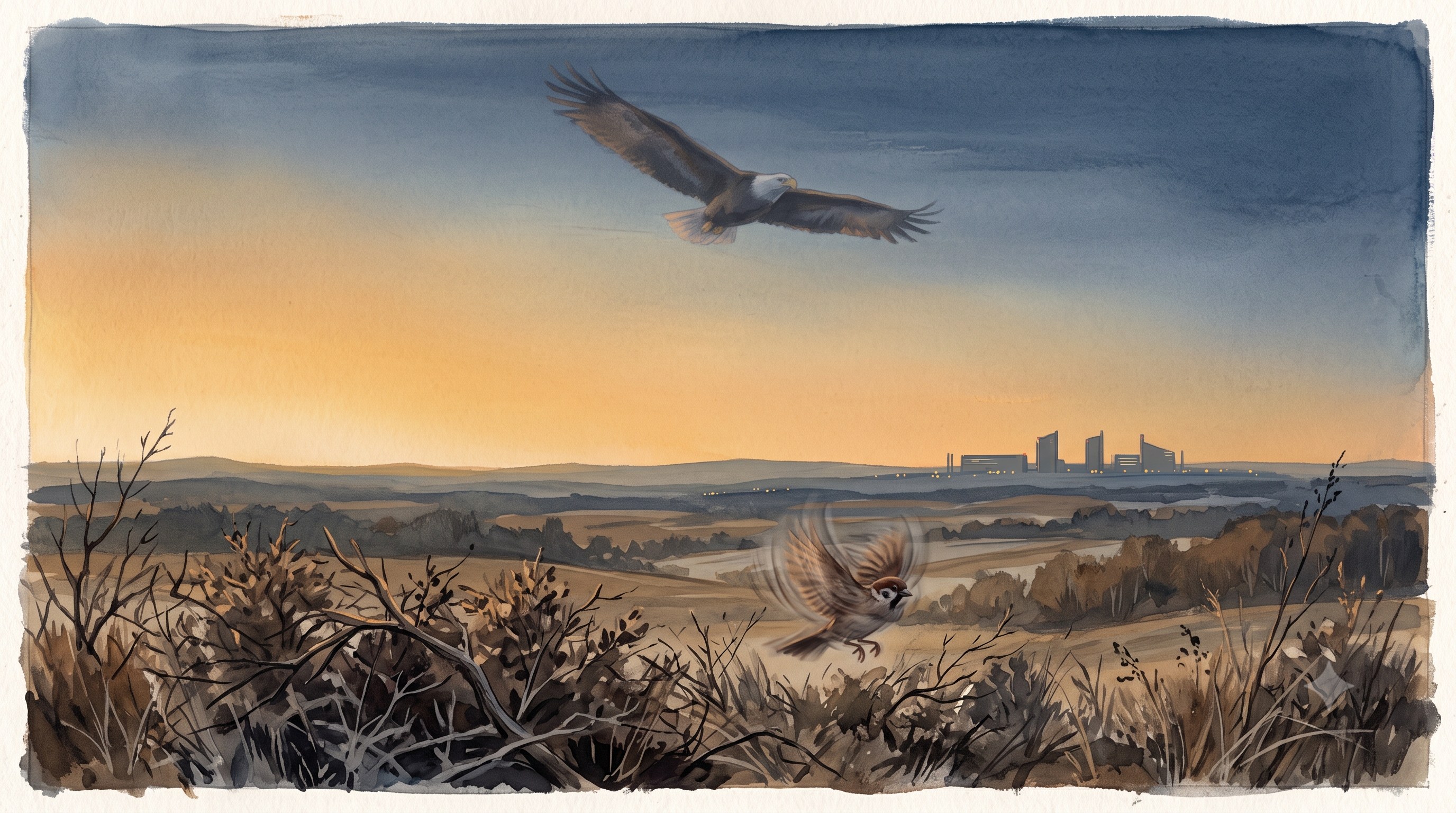
The clearest instance came from one member who had just returned from a Deep Tech Week conference in San Francisco. He had brought a story back with him — a small ordinary moment from a trek with his son, now in his 20s. They were on a trail, and they watched an eagle glide overhead. The son said something like: notice how the eagle barely flaps. It spreads its wings, finds the wind, stays up there. The sparrows down here are exhausting themselves. His son then connected the observation to a fireside chat he had just heard at the conference — a founder saying that in the age of AI we need to start treating our employees the way sports teams treat athletes. Rest, recovery, nutrition, breaks, mind. The economy of the flapping worker no longer works. The eagle is the professional now.
But the member who brought the story wasn’t offering it as a productivity metaphor. He came back to it later in the night with a sharper claim. What the eagle actually practices, he said, is non-doing. Not rest, not recovery — a deliberate discipline of not moving until it is time to strike, and then striking once, decisively, across a horizon it has been watching the whole time.
"The act of not doing anything — non-doing — is what the eagle practices."
He was honest that even understanding this, he still catches himself feeling he isn’t doing enough — that at the speed AI now makes possible, any slowness reads to him as slacking. Learning not to judge himself by the sparrow’s metric is, he said, the actual practice.
Something in the story reorganized the rest of the meeting.
Members started naming, without prompting, the small acts of gliding they had made in the past week. One had committed to a co-working space to create more focus and commitment to this work, ending a stretch of trying to work from a house that had been distracting him for months. Another had made the decision to leave a role he had been dreading — leave gracefully, on good terms — and within days had two better offers on the table, neither of which he had applied for. Another had taken the strange step, mid-morning on a Sunday, of gathering up a box of letters and documents from a relationship long ended and burning them in a ceremony he made up on the spot. He said a lightness filled him afterward that felt like the emotional equivalent of prior meetings’ discussion about closing mental programs.
These were not productivity wins, but a deeper recognition of what each person had been flapping about and choosing to stop.
We then shifted to the conference report, which largely offered new perspectives and examples that confirmed what we had already felt was true. One of the most useful phrases reported from Deep Tech Week landed hard in the room — tribal knowledge. The idea that the deepest value a long-tenured employee produces is not their explicit output but the undocumented, half-conscious pattern recognition they have accumulated in a body over decades, and that AI’s near-term win for most traditional businesses is capturing that tacit knowledge before it walks out the door with the person carrying it. The phrase landed because it named what the room had each been carrying without naming: the accumulated, mostly wordless competence of people who have done a thing for a long time — the way a good manager reads a room, the way a good engineer smells a bad architecture. The language had been trying to arrive in our heads for years, and it felt empowering to realize the potential of AI to document and distribute this vital knowledge.
A ripple of awareness seemed to cross the room, and one member cited how this is the real technology of franchising: bringing processes down to their most efficient and repeatable version so that they can scale. Imagining that AI could potentially do this for more sophisticated businesses felt — as with almost all other aspects of AI — both incredibly compelling (because of the profit potential) and terrifying (because of the job loss and consolidation of wealth and power it could create).
The other beats from the conference — the rotation of venture capital away from software and toward physical world technology, the plummeting cost of compute, the orders-of-magnitude acceleration of scientific research when AI is applied to it — were interesting, and the room engaged with them seriously, though as context rather than center. The center was the shift already underway: the categories our lives run on and the categories our work runs on are starting to move toward each other. As one conference speaker said, “The world transacts in prototypes now, not slide decks” — a line that rhymed with last week’s insight that intent is the actual constraint on building, since code is no longer the constraint. Prototypes are what happen when someone knows what they want to make; slide decks are what happen when they are still deciding.
Somewhere past the midpoint of the meeting, a member offered a quieter and darker observation. Technology accelerating faster than the culture around it can absorb produces a specific response, and the response is not disagreement but rejection. When the pace of change outruns the general capacity to comprehend, the crowd does not evaluate what it is seeing; the crowd throws it out. He walked through some historical parallels and cited models predicting a similar moment arriving inside the next twenty years, driven precisely by the velocity we had spent the evening celebrating.
Which put the room in an interesting position. We had spent meeting four on the darkly comic inversion of Margaret Mead — never doubt the power of organized idiots — and now we were sitting with the same phrase in a darker key. Small groups of committed people organize to build, and small groups of overwhelmed people organize to destroy; both are small groups, both are organized, both are entirely capable of setting the terms of the era they are in. The eagle and the sparrow are also both part of the same weather.
There is no clean answer to any of this, and the room did not try to arrive at one.
At the top of each hour, the practice returned. One of us called the time aloud and the room fell silent together — mid-sentence, mid-thought, whichever. Knowing we will die, how do we want to live the next hour? The memento mori meditation has been sitting inside every meeting we have held, and each week it finds a slightly different door in the conversation. This week the door was the eagle. Both are asking the same question in different tenses: what is worth doing with the day, given that the day will end, and what am I flapping about that no wind is lifting me to soar above?
Eight weeks in, the tools and tactics we discuss in the meeting have stopped being the point: what is happening inside the meeting, or how it is rippling out into our lives, has become the point. Members are seeing changes in their lives that mirror what they see these tools doing in their work, and the path of building their businesses feels analogous to the path of building their lives. The vocabulary bleeds both ways, and we find ourselves returning to the heart of where much of this began … as a spiritual practice in the realm of business.
One thing about the eagle, though: it does not decide to glide, only how to be carried by the wind.
The organized idiots meet again next Wednesday.
If you are not yet in the room and want to be, you can request an invitation.
— Jeremy