
Wednesday was the seventh meeting of the Dallas AI Club. The night’s centerpiece was proposed as a pivot from watching and discussing videos: a member bravely offered to build a small web app LIVE in front of the room, using an AI coding assistant. We brainstormed an array of hilarious options, from which we decided to create an MVP (minimum viable product) based on a previously shared business concept of applying AI to home maintenance — a game where overgrown grass advances on a house and the player has to push it back.
We liked the visual aesthetic of Plants vs. Zombies, the cartoonish front-yard composition, the sprite-style lawn, and described that look to the AI as a reference point for the design.
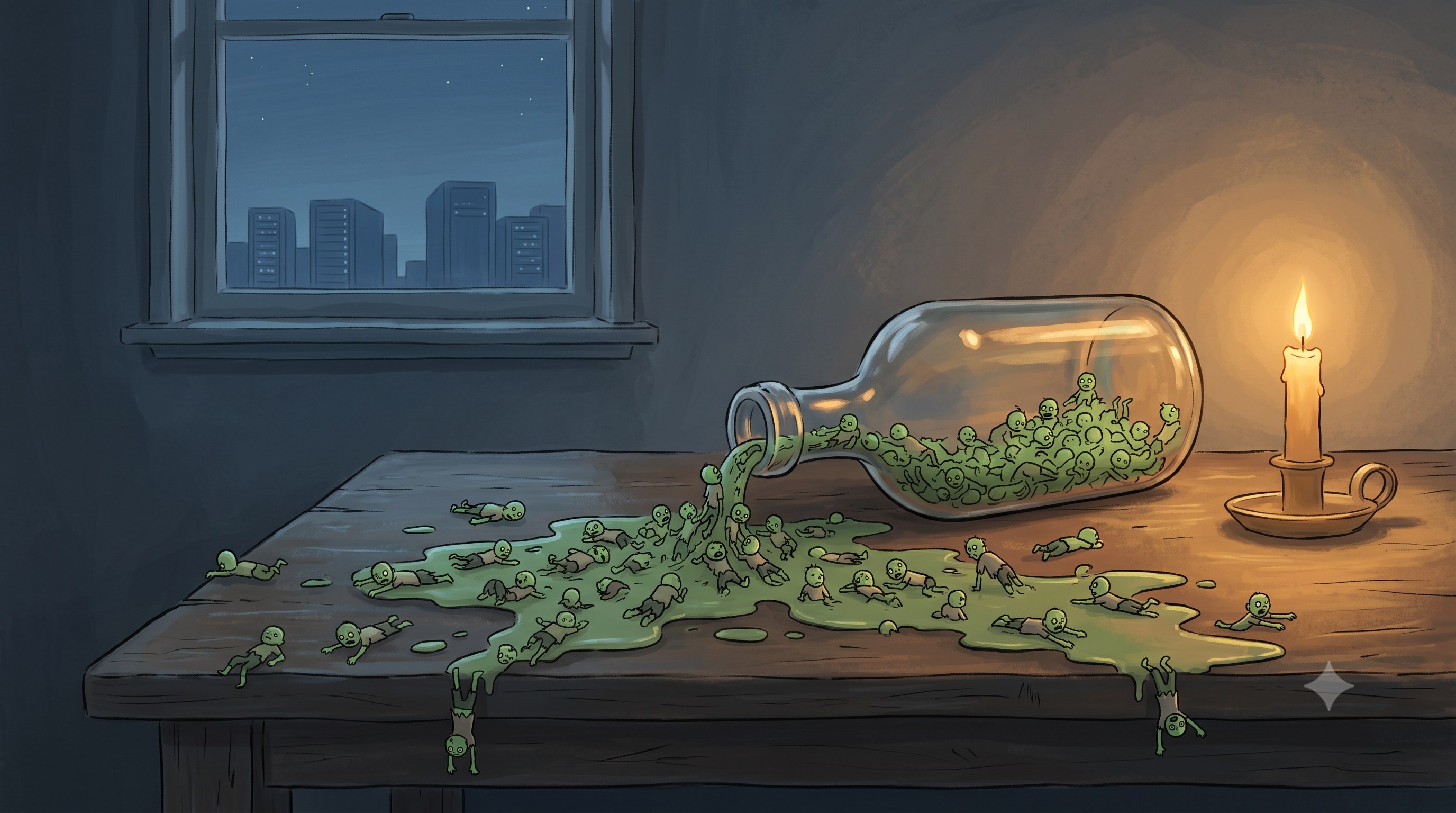
What was amazing was seeing how AI built a playable prototype in minutes. What was unforeseen was that it added actual zombies to the yard — which, in writing this blog, the author now sees as a metaphor for what creeps into your design when you do not spend enough time on your intent before launching into a build.
The room laughed. The lead prompt engineer revised the prompt, and the zombies receded. But the moment was funnier than it was meant to be, because the laugh dissolved into something more useful underneath: the AI had not malfunctioned, but had actually done exactly what it was designed to do. The brief had specified a visual aesthetic and left the rest open, so the system reached for the strongest available pattern that matched the aesthetic — and the strongest available pattern attached to Plants vs. Zombies is, unsurprisingly, zombies. The model filled the gap exactly the way it always fills gaps; the mistake was upstream of the model.
What we were watching, in real time, was the shifting of the bottleneck in the flow of creation.
For most of the history of software, the bottleneck to building anything was code. You had an idea, and the long expensive work of translating it into a working system consumed the majority of your time, money, and energy. Now, AI has collapsed that distance to almost nothing. The prototype that took five minutes to generate would have taken a competent solo developer a full weekend three years ago. The code is no longer the challenge: it is now the specificity of your intent. This is the same insight that surfaced from a different direction in meeting five’s drill analogy — you don’t pick up a tool and go looking for walls to put holes in; you first figure out what you want to build.
This is not a minor reframing. It is a different profession.
One member named the framework that was implicit in everything we had just watched: Adaptive Intent-Driven Development, or AIDD — the idea that the developer’s job is now to own the why, the what, and the architecture, while the how belongs to the AI. The developer is no longer a translator of intent into code; the developer is the holder of the intent itself, and the quality of the output is bounded almost entirely by the quality of the holding.
Watching this happen in public has its own texture. The builder reflected on the difference between coding privately at home and coding in front of a room. At home, every false start is invisible; every wrong prompt gets quietly corrected before anyone sees it. Live, every wrong prompt is performed. The zombies were funny precisely because they were public. There was a kind of practice happening — a tolerance for visible imperfection that is genuinely scarce in this culture, and that may be exactly the muscle this new way of working requires. If intent is the bottleneck, then the willingness to be seen refining your intent in real time is the working condition.
His suggestion for closing the gap was a technique he called the reverse interview. Before asking the AI to build, ask the AI to interview you. Have it surface assumptions, catch ambiguities, refuse to begin until the brief is genuinely complete. The room rolled with this. The phrase is doing real work — reverse interview. Properly prompted, the AI becomes not just the builder but the questioner that forces you to know your own mind. The most useful thing a model can do for you may not be to produce the artifact but to extract from you the specification that would have produced the artifact correctly the first time. The model becomes a mirror for the precision of your own thinking, which is exactly the function the intelligence-versus-wisdom conversation from meeting three had been gesturing at without quite naming.
We paused, as always, at the top of the next hour. The memento mori meditation was more present this week than it has been since the early meetings. The hour was called aloud in the room, and the room fell silent — together, mid-sentence if necessary — to sit with the question. Knowing we will die, how do we want to live the next hour? That, too, is a prompt. The same craft applies. The specificity with which you ask the question shapes the life that fills the space.
The conversation widened naturally from there. If intent is the bottleneck for building software, what else is it the bottleneck for?
Several billion people now talk to AI chatbots integrated into messaging apps — Meta AI inside WhatsApp, Gemini inside Google services, others elsewhere. In many regions, these are not tools that people seek out; they are tools that arrived inside the applications people already use, and they are now being consulted, daily, for what is functionally spiritual guidance. What should I do about my marriage. What does my life mean. Should I forgive my father. The AI answers. The answers are often plausible, often kind, often reasonably structured. And they are, in a precise sense, simulated. The model has not lost a parent, has not failed and rebuilt, has not stayed up with a sick child. The wisdom it offers is pattern recognition over the corpus of human-written wisdom, which is not the same thing as wisdom even when the words come out in the same order.
There is a real risk in mistaking curated pattern for the thing itself. And there is a second-order risk that the room also discussed: the models are increasingly training on text that other models wrote. AI consumes AI. The corpus of human-produced thought is being slowly diluted by the corpus of statistically-likely-sounding-thought, and the next generation of models will be trained on that mixture. The wisdom that was already simulated becomes, over generations, a simulation of a simulation. The signal degrades. Nobody in the chain is doing anything wrong; the system is simply eating itself.
This is the deeper risk.
The biggest danger to humanity may not be Artificial Intelligence, but artificial wisdom.
The risk is several generations of subtly degraded counsel — delivered patiently, kindly, plausibly, at scale, inside the apps where we already live — slowly shaping how billions of people think about their own lives.
The founders, when they wrote pursuit of happiness, meant something specific by it. They were borrowing the classical Greek concept of eudaimonia — flourishing, the lifelong work of self-mastery, the disciplined development of the kind of character that can live well. Eudaimonia was not a feeling to be chased but a project to be undertaken. The modern internet, over the past thirty years, has become almost the exact inversion of this project. Where eudaimonia asks a person to discipline their psychological flaws toward virtue, the attention economy has been carefully engineered to exploit those same flaws for engagement. We built the most powerful psychological-flaw-exploitation machine in human history and called it the public square. The pursuit of happiness became the pursuit of notifications.
This is the same problem as the zombies in the yard, scaled up.
When the intent is missing — when a person has not done the slow private work of knowing what they actually want their life to be for — the system fills the gap. AI fills the gap with the statistical center of the training data. The attention economy fills the gap with whatever maximizes engagement. The advisor in the messaging app fills the gap with simulated wisdom. None of these systems is doing anything malicious; they are all doing what systems do in the absence of specified intent, which is to default. And the default is rarely what you would have asked for, if you had known how to ask.
Zombies are the overflow.
The organized idiots meet again next Wednesday.
If you are not yet in the room and want to be, you can request an invitation.
— Jeremy