
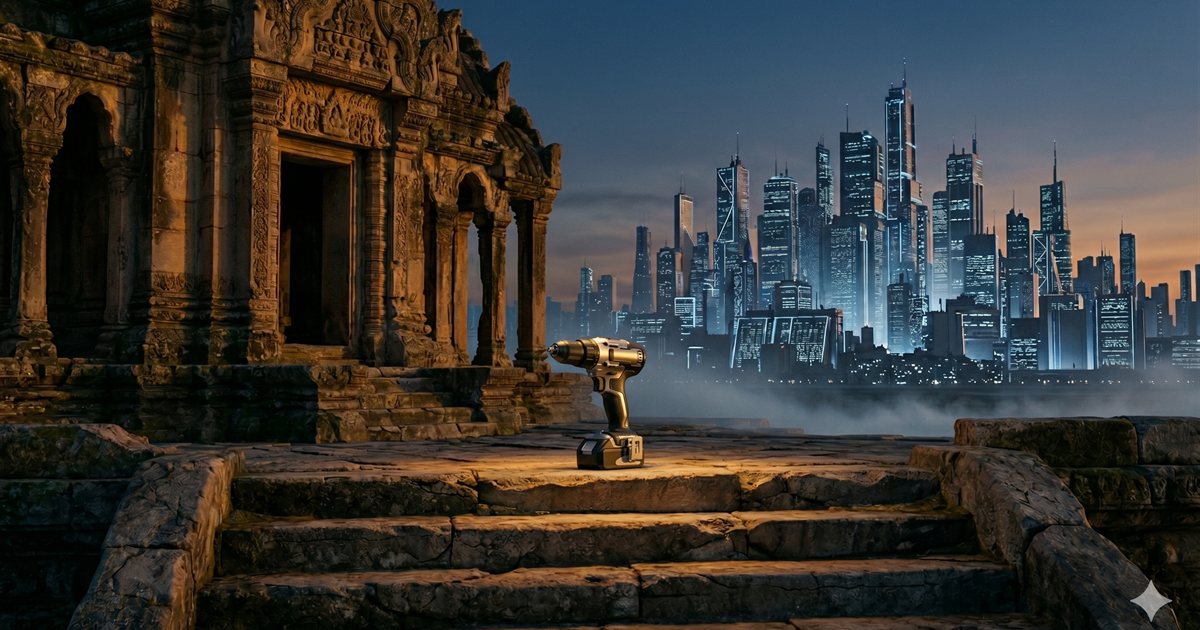
Wednesday was the fifth meeting of the Dallas AI Club. The room arrived a little under water — several members in a row naming versions of the same difficulty, an opportunity paralysis that has been deepening across the club for weeks. Then one of the more practical-minded members in the room dropped a line that turned the night sideways. He said it the way you say something obvious. You don’t pick up a drill and go around looking for walls to drill holes in. You first figure out what you want to build; then you ask if a drill is the right tool.
We had been spending all our time asking what can this tool do, when the only question that ever mattered was what do I want to make. The tool is a means, and we had been treating it as the question itself. Of course we were paralyzed. We had inverted the relationship.
The reframe lands obviously enough once you hear it. It is not obvious from inside the storm. From inside the storm, every new model release feels like a thing that must be learned, and the time you spend learning it is time you do not spend making anything. One member had been trying and failing to build a simple agent to automate updates for a rental property he manages. Another had become trapped in what he called research mode, using the dopamine of discovering new AI tools as a substitute for actually building with the ones he already had. Research mode looks like work. It is a form of avoidance dressed in productivity.
Once the room shifted from what can AI do to what real problem do I want to solve, the conversation changed shape. The anxiety thinned out. People started naming specific problems in their own lives that AI might actually help with, and the tools became, for a while, what they were supposed to be: instruments.
Under the drill analogy, though, sat something heavier. One member had recently had a profound somatic experience — a meditative state in which he truly, fully believed he had one hour left to live. The hour was an experience, not a hypothetical. And during that hour, he said, everything he had been spending his life on became visible in its actual proportions. The frantic accumulation of wealth. The careful avoidance of discomfort. The endless small optimizations that fill an unexamined day. None of it survived contact with the hour. What remained was presence, the people he loved, and the question of what he was making with the time.
He shared this with the room as if he were offering us a gift, which he was. Because the drill analogy and the death realization are the same realization, scaled differently. Once you have actually felt the hour, the question of what to make stops being abstract. It becomes the only honest question there is. The tool becomes whatever helps you make the thing. The model release becomes background noise. The week of opportunity paralysis becomes something to walk gently out of rather than a verdict on your worth.
The memento mori meditation we open and close every meeting with sat more in the background this week. One of us had already brought the hour of his death into the center of the room, and the rest of the night was held inside that tenor whether the bell rang or not.
It was in this register that we watched a recent interview with venture capitalist Vinod Khosla.
Khosla’s vision for 2040 is the most optimistic thing any of us had heard in a long time — though his optimism comes partly from being a billionaire with a vested interest in our believing him, and with no real personal risk if he turns out to be wrong. He was, after all, one of the earliest major investors in OpenAI. Even so, the vision was delivered with the unhurried confidence of someone who has spent a career being right about the future, and several of us decided to postpone our skepticism long enough to actually hear him out.
His central claim is that we are entering an Age of Abundance, in which the historical scarcity of expertise and labor will simply end. By 2040, in his view, AI will be capable of performing eighty percent of all jobs. The expertise of an oncologist will cost no more than the expertise of a farm worker, because the underlying intelligence will be effectively free. A five-year-old today, he argues, will likely never look for a job in the way previous generations have understood that phrase; robots costing a few hundred dollars a month will handle most physical labor, and human attention will be freed for what he calls passion-driven fulfillment — creating, teaching, exploring, raising children, building communities.
The policy implications he draws from this are radical. He proposes eliminating the tax preference for capital gains, taxing all income — labor or investment — as ordinary income, so that the gains of an AI-driven economy do not concentrate entirely in the hands of asset-holders. He proposes a hundred-thousand-dollar tax-free threshold, so that nobody earning a working-or-middle-class living pays income tax at all. He proposes universal basic services — free high-level education, free healthcare, eventually free energy from fusion — funded by the deflationary windfall of AI’s productivity gains. And he reframes economic success itself: in his model, a successful economy is no longer measured by rising GDP and controlled inflation, but by deflation — by the steady falling of prices that signals abundance is reaching everyone.
He also frames the global situation as what he calls a technomic war with China. Whichever country reaches the new abundance first, he argues, will set the socioeconomic and ideological terms of the next century. He is unambiguous about which side he is on, and the urgency in his voice makes you feel the stakes.
Even the skeptics in the room had to admit it was a beautiful vision. We began to wonder what it might look like to help make some of it real. And then the member who had brought us the image of the drill spoke again, offering a counter that the night could not shake off.
He told us about a phenomenon from the Indian temple tradition that he called the Temple Beggar’s Paradox. The tradition is ancient: pilgrims visiting a temple would, as an act of devotion and merit, give alms to the beggars gathered at its gates. The giving was voluntary. The receiving was understood as grace. Over generations, the gift became expectation. The expectation became entitlement. And eventually, in his telling, the beggars at certain temples unionized. They set minimum donation amounts. They harassed visitors who failed to meet the new standard. The gift, which had been the spiritual transaction at the heart of the temple, became a tax, and the relationship between giver and receiver was inverted. The temple itself, the institution that had created and sustained the practice, became the target of the resentment it had inadvertently fed.
The lesson he drew from this is not anti-charity. It is something more specific and more disturbing. When necessity is removed from human life without being replaced by a rigorous, generative sense of purpose, the vacuum does not stay empty. It fills with resentment toward whatever provides the abundance. The pattern is older than India. Rome eventually fell into bread-and-circuses dependence and tore itself apart. The Library of Alexandria — the greatest intellectual institution of the ancient world — was destroyed by the very society it had served. He pointed to these as warnings about Khosla’s utopia. Universal basic services are not the same as universal basic purpose. You can solve the survival problem and still produce a society that, having forgotten what to do with itself, turns on the engine of its own freedom.
This is the real question Khosla and the Temple Beggar are arguing about, and they are arguing about the same thing. Both visions accept that AI will dissolve survival labor. They disagree about whether the species can survive its own success. And the question they share is the question the drill analogy points at and the somatic death realization makes urgent: what is a human being for, once survival is solved? What do we actually want to make with our hours, when the hours are no longer spoken for by the need to eat?
What is a human being for, once survival is solved?
The Dallas AI Club has now spent five Wednesdays arriving at this question from different doors. In meeting two it arrived as opportunity paralysis — the question of what to do when every direction is plausible. In meeting three it arrived as the gap between intelligence and wisdom — the question of what a body and mortality contribute that a machine cannot replicate. In meeting four it arrived as Margaret Mead’s small group of committed citizens, and the latecomer’s comic mirror of her line: never doubt the power of organized idiots. This week it arrived through a drill, a death, and a temple. Each door opens onto the same room. We keep walking in.
Toward the end of the night, one member asked the room what each of us would actually do if money were no longer the question. If Khosla’s deflationary abundance arrived tomorrow and the survival problem dissolved, what then?
His own answer, when his turn came, was specific in a way that surprised the room. He would spend the rest of his life cocreating stories, music, and films with his closest business partners. Not selling things. Not optimizing things. Making things. The selling had been the cost of admission to a life in which he got to keep working with the people he loved working with. If the cost of admission were waived, he would put down the selling and pick up the making.
Other answers came around the circle. They were specific, and they were varied, and most of them surprised the person giving them.
What surfaced underneath every answer was the same uncomfortable fact: none of us has yet built our lives around the answer we just gave. That gap, between what we would do and what we are actually doing, is the work of this moment for each of us. The drill analogy is its entry point. Stop staring at the tools. Look at the wall. Pick up what makes the hole.
The Age of Abundance, if it arrives, will not save anyone from this question. It will only sharpen it. The Temple Beggar’s Paradox is a warning that abundance without purpose corrodes the institutions that produced it. The somatic death realization is the antidote, scaled down to a single human hour. The drill is the daily practice.
The organized idiots meet again next Wednesday.
If you are not yet in the room and want to be, you can request an invitation.
— Jeremy